|
 |
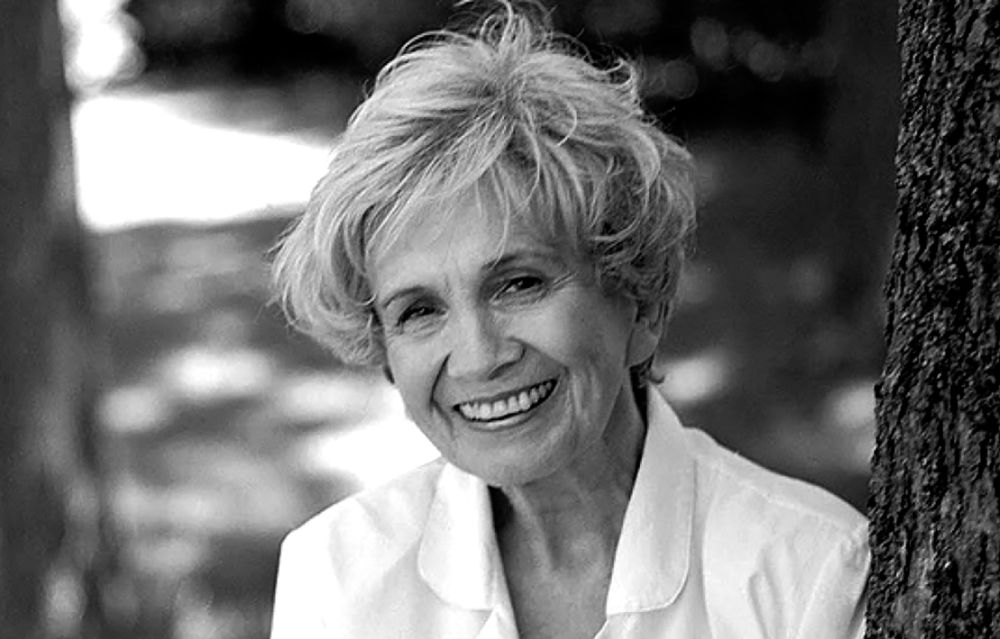
There is no direct flight from New York City to Clinton, Ontario, the Canadian town of three thousand where Alice Munro lives most of the year. We left LaGuardia early on a June morning, rented a car in Toronto, and drove for three hours on roads that grew smaller and more rural. Around dusk, we pulled up to the house where Munro lives with her second husband, Gerry Fremlin. It has a deep backyard and an eccentric flower garden and is, as she explained, the house where Fremlin was born. In the kitchen, Munro was preparing a simple meal with fragrant local herbs. The dining room is lined floor to ceiling with books; on one side a small table holds a manual typewriter. It is here that Munro works.
After a while, Munro took us to Goderich, a bigger town, the county seat, where she installed us in the Bedford Hotel on the square across from the courthouse. The hotel is a nineteenth-century building with comfortable rooms (twin beds and no air-conditioning) that would seem to lodge a librarian or a frontier schoolteacher in one of Munros stories. Over the next three days, we talked in her home, but never with the tape recorder on. We conducted the interview in our small room at the hotel, as Munro wanted to keep the business out of the house. Both Munro and her husband grew up within twenty miles of where they now live; they knew the history of almost every building we passed, admired, or ate inside. We asked what sort of literary community was available in the immediate area. Although there is a library in Goderich, we were told the nearest good bookstore was in Stratford, some thirty miles away. When we asked whether there were any other local writers, she drove us past a ramshackle house where a man sat bare chested on the back stoop, crouched over a typewriter, surrounded by cats. Hes out there every day, she said. Rain or shine. I dont know him, but Im dying of curiosity to find out what hes up to.
Our last morning in Canada, supplied with directions, we sought out the house in which Alice Munro had grown up. Her father had built the house and raised mink there. After several dead ends, we found it, a pretty brick house at the very end of a country road, facing an open field where an airplane rested, alighted temporarily it seemed. It was, from our spot, easy to imagine the glamor of the air, the pilot taking a country wife away, as in White Dump, or the young aviation stuntsman who lands in a field like this in How I Met My Husband.
Like the house, like the landscape of Ontario, which resembles the American Midwest, Munro is not imposing. She is gracious, with a quiet humor. She is the author of seven books of short stories, including the forthcoming Open Secrets, and one novel, Lives of Girls and Women; she has received the Governor-Generals Award (Canadas most prestigious literary prize), and is regularly featured in Best American Short Stories (Richard Ford recently included two Alice Munro stories in the volume he edited), and Prize Stories: The O. Henry Awards; she also is a regular contributor to The New Yorker. Despite these considerable accomplishments, Munro still speaks of writing with some of the reverence and insecurity one hears in the voices of beginners. She has none of the bravura or bluster of a famous writer, and it is easy to forget that she is one. Speaking of her own work, she makes what she does sound not exactly easy, but possible, as if anyone could do it if they only worked hard enough. As we left, we felt that contagious sense of possibility. It seems simple—but her writing has a perfect simplicity that takes years and many drafts to master. As Cynthia Ozick has said, She is our Chekhov and is going to outlast most of her contemporaries.
—Jeanne McCulloch, Mona Simpson
INTERVIEWER
We went back to the house where you grew up this morning: did you live there your entire childhood?
ALICE MUNRO
Yes. When my father died, he was still living in that house on the farm, which was a fox and mink farm. Its changed a lot though. Now its a beauty parlor called Total Indulgence. I think they have the beauty parlor in the back wing, and theyve knocked down the kitchen entirely.
INTERVIEWER
Have you been inside it since then?
MUNRO
No I havent, but if I did Id ask to see the living room. Theres the fireplace my father built and Id like to see that. Ive sometimes thought I should go in and ask for a manicure.
INTERVIEWER
We noticed a plane on the field across the road and thought of your stories White Dump and How I Met My Husband.
MUNRO
Yes, that was an airport for a while. The man who owned that farm had a hobby of flying planes, and he had a little plane of his own. He never liked farming so he got out of it and became a flight instructor. Hes still alive. In perfect health and one of the handsomest men Ive ever known. He retired from flight instruction when he was seventy-five. Within maybe three months of retirement he went on a trip and got some odd disease you get from bats in caves.
INTERVIEWER
The stories in your first collection, Dance of the Happy Shades, are very resonant of that area, the world of your childhood. At what point in your life were those stories written?
MUNRO
The writing of those stories stretched over fifteen years. The Day of the Butterfly was the earliest one. That was probably written when I was about twenty-one. And I can remember very well writing Thanks for the Ride because my first baby was lying in the crib beside me. So I was twenty-two. The really late stories were written in my thirties. Dance of the Happy Shades is one; The Peace of Utrecht is another. Images is the very latest. Walker Brothers Cowboy was also written after I was thirty. So theres a really great range.
INTERVIEWER
How do they seem to hold up now? Do you reread them?
MUNRO
Theres an early one in that collection called The Shining Houses, which I had to read at Harborfront in Toronto two or three years ago for a special event celebrating the history of Tamarack Review. Since it was originally published in one of the early issues of that magazine, I had to get up and read it, and it was very hard. I think I wrote that story when I was twenty-two. I kept editing as I read, catching all the tricks I used at that time, which now seemed very dated. I was trying to fix it up fast, with my eyes darting ahead to the next paragraph as I read, because I hadnt read it ahead of time. I never do read things ahead of time. When I read an early story I can see things I wouldnt do now, things people were doing in the fifties.
INTERVIEWER
Do you ever revise a story after its been published? Apparently, before he died, Proust rewrote the first volumes of Remembrance of Things Past.
MUNRO
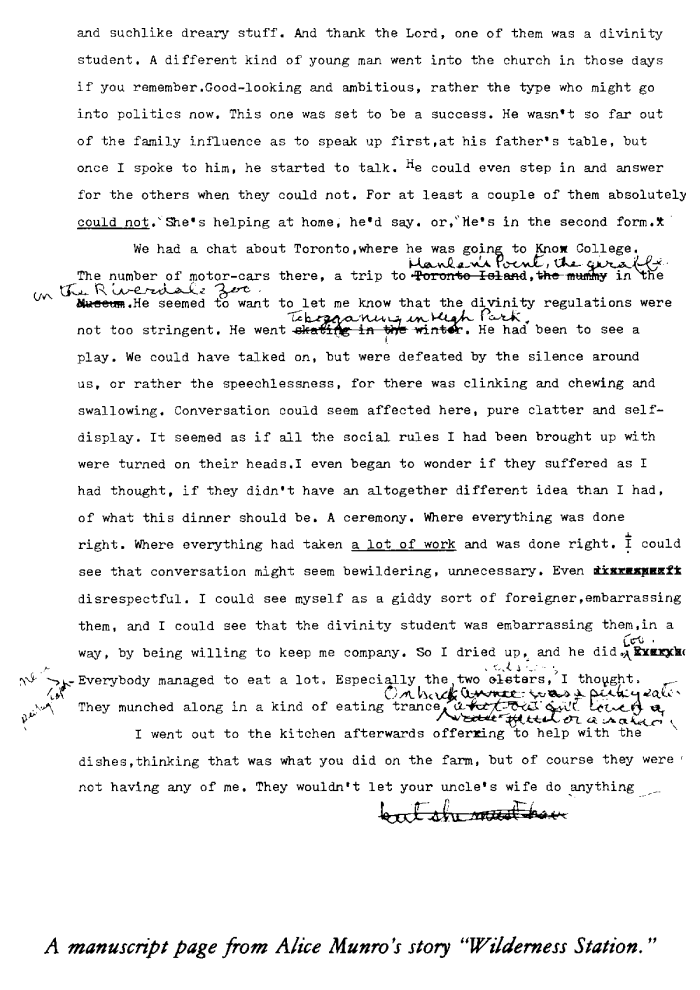
Yes, and Henry James rewrote simple, understandable stuff so it was obscure and difficult. Actually Ive done it recently. The story Carried Away was included in Best American Short Stories 1991. I read it again in the anthology, because I wanted to see what it was like and I found a paragraph that I thought was really soggy. It was a very important little paragraph, maybe two sentences. I just took a pen and rewrote it up in the margin of the anthology so that Id have it there to refer to when I published the story in book form. Ive often made revisions at that stage that turned out to be mistakes because I wasnt really in the rhythm of the story anymore. I see a little bit of writing that doesnt seem to be doing as much work as it should be doing, and right at the end I will sort of rev it up. But when I finally read the story again it seems a bit obtrusive. So Im not too sure about this sort of thing. The answer may be that one should stop this behavior. There should be a point where you say, the way you would with a child, this isnt mine anymore.
INTERVIEWER
Youve mentioned that you dont show your works in progress to friends.
MUNRO
No, I dont show anything in progress to anybody.

INTERVIEWER
How much do you rely on your editors?
MUNRO
The New Yorker was really my first experience with serious editing. Previously Id more or less just had copyediting with a few suggestions—not much. There has to be an agreement between the editor and me about the kind of thing that can happen. An editor who thought nothing happened in William Maxwells stories, for example, would be of no use to me. There also has to be a very sharp eye for the ways that I could be deceiving myself. Chip McGrath at The New Yorker was my first editor, and he was so good. I was amazed that anybody could see that deeply into what I wanted to do. Sometimes we didnt do much, but occasionally he gave me a lot of direction. I rewrote one story called The Turkey Season, which he had already bought. I thought he would simply accept the new version but he didnt. He said, Well, there are things about the new version I like better, and there are things about the old version I like better. Why dont we see? He never says anything like, We will. So we put it together and got a better story that way, I think.
INTERVIEWER
How was this accomplished? By phone or by mail? Do you ever go into The New Yorker and hammer it out?
MUNRO
By mail. We have a very fruitful phone relationship, but weve only seen each other a few times.
INTERVIEWER
When did you first publish in The New Yorker?
MUNRO
Royal Beatings was my first story, and it was published in 1977. But I sent all my early stories to The New Yorker in the 1950s, and then I stopped sending for a long time and sent only to magazines in Canada. The New Yorker sent me nice notes though—penciled, informal messages. They never signed them. They werent terribly encouraging. I still remember one of them: The writing is very nice, but the theme is a bit overly familiar. It was, too. It was a romance between two aging people—an aging spinster who knows this is it for her when shes proposed to by an aging farmer. I had a lot of aging spinsters in my stories. It was called The Day the Asters Bloomed. It was really awful. And I didnt write this when I was seventeen; I was twenty-five. I wonder why I wrote about aging spinsters. I didnt know any.
INTERVIEWER
And you married young. Its not as though you were anticipating a life as an aging spinster.
MUNRO
I think I knew that at heart I was an aging spinster.
INTERVIEWER
Were you always writing?
MUNRO
Since about grade seven or eight.
INTERVIEWER
Were you a serious writer by the time you went to college?
MUNRO
Yes. I had no chance to be anything else because I had no money. I knew I would only be at university two years because the scholarships available at that time lasted only two years. It was this little vacation in my life, a wonderful time. I had been in charge of the house at home when I was in my teens, so university was about the only time in my life that I havent had to do housework.
INTERVIEWER
Did you get married right after your two years?
MUNRO
I got married right after the second year. I was twenty. We went to Vancouver. That was the big thing about getting married—this huge adventure, moving. As far away as we could get and stay in the country. We were only twenty and twenty-two. We immediately set up a very proper kind of middle-class existence. We were thinking of getting a house and having a baby, and we promptly did these things. I had my first baby at twenty-one.
INTERVIEWER
And you were writing all through that?
MUNRO
I was writing desperately all the time I was pregnant because I thought I would never be able to write afterwards. Each pregnancy spurred me to get something big done before the baby was born. Actually I didnt get anything big done.
INTERVIEWER
In Thanks for the Ride, you write from the point of view of a rather callous city boy who picks up a poor town girl for the night and sleeps with her and is alternately attracted to and revolted by the poverty of her life. It seems striking that this story came from a time when your life was so settled and proper.
MUNRO
A friend of my husbands came to visit us the summer when I was pregnant with my eldest daughter. He stayed for a month or so. He worked for the National Film Board, and he was doing a film up there. He told us a lot of stuff—we just talked the way you do, anecdotally about our lives. He told the story about being in a small town on Georgian Bay and going out with a local girl. It was the encounter of a middle-class boy with something that was quite familiar to me but not familiar to him. So I immediately identified strongly with the girl and her family and her situation, and I guess I wrote the story fairly soon afterwards because my baby was looking at me from the crib.
INTERVIEWER
How old were you when that first book came out?
MUNRO
I was about thirty-six. Id been writing these stories over the years and finally an editor at Ryerson Press, a Canadian publisher that has since been taken over by McGraw-Hill, wrote and asked me if I had enough stories for a book. Originally he was going to put me in a book with two or three other writers. That fell through, but he still had a bunch of my stories. Then he quit but passed me onto another editor, who said, If you could write three more stories, wed have a book. And so I wrote Images, Walker Brothers Cowboy, and Postcard during the last year before the book was published.
INTERVIEWER
Did you publish those stories in magazines?
MUNRO
Most of them got into Tamarack Review. It was a nice little magazine, a very brave magazine. The editor said he was the only editor in Canada who knew all his readers by their first names.
INTERVIEWER
Have you ever had a specific time to write?
MUNRO
When the kids were little, my time was as soon as they left for school. So I worked very hard in those years. My husband and I owned a bookstore, and even when I was working there, I stayed at home until noon. I was supposed to be doing housework, and I would also do my writing then. Later on, when I wasnt working everyday in the store, I would write until everybody came home for lunch and then after they went back, probably till about two-thirty, and then I would have a quick cup of coffee and start doing the housework, trying to get it all done before late afternoon.
INTERVIEWER
What about before the girls were old enough to go to school?
MUNRO
Their naps.
INTERVIEWER
You wrote when they had naps?
MUNRO
Yes. From one to three in the afternoon. I wrote a lot of stuff that wasnt any good, but I was fairly productive. The year I wrote my second book, Lives of Girls and Women, I was enormously productive. I had four kids because one of the girls friends was living with us, and I worked in the store two days a week. I used to work until maybe one oclock in the morning and then get up at six. And I remember thinking, You know, maybe Ill die, this is terrible, Ill have a heart attack. I was only about thirty-nine or so, but I was thinking this; then I thought, Well even if I do, Ive got that many pages written now. They can see how its going to come out. It was a kind of desperate, desperate race. I dont have that kind of energy now.
INTERVIEWER
What was the process involved in writing Lives?
MUNRO
I remember the day I started to write that. It was in January, a Sunday. I went down to the bookstore, which wasnt open Sundays, and locked myself in. My husband had said he would get dinner, so I had the afternoon. I remember looking around at all the great literature that was around me and thinking, You fool! What are you doing here? But then I went up to the office and started to write the section called Princess Ida, which is about my mother. The material about my mother is my central material in life, and it always comes the most readily to me. If I just relax, thats what will come up. So, once I started to write that, I was off. Then I made a big mistake. I tried to make it a regular novel, an ordinary sort of childhood adolescence novel. About March I saw it wasnt working. It didnt feel right to me, and I thought I would have to abandon it. I was very depressed. Then it came to me that what I had to do was pull it apart and put it in the story form. Then I could handle it. Thats when I learned that I was never going to write a real novel because I could not think that way.
INTERVIEWER
The Beggar Maid, too, is a sort of a novel because its interconnected stories.
MUNRO
I dont want to second-guess things too much, but Ive often wanted to do another series of stories. In my new book, Open Secrets, there are characters who reappear. Bea Doud in Vandals is mentioned as the little girl in Carried Away, which is the first story I wrote for the collection. Billy Doud is the son of the librarian. Theyre all mentioned in Spaceships Have Landed. But I mustnt let this sort of plan overtake the stories themselves. If I start shaping one story so it will fit with another, I am probably doing something wrong, using force on it that I oughtnt. So I dont know that Ill ever do that kind of series again, though I love the idea of it. Katherine Mansfield said something in one of her letters like, Oh, I hope I write a novel, I hope I dont die just leaving these bits and pieces. Its very hard to wean yourself away from this bits-and-pieces feeling if all youre leaving behind is scattered stories. Im sure you could think of Chekhov and everything, but still.
INTERVIEWER
And Chekhov always wanted to write a novel. He was going to call it Stories from the Lives of My Friends.
MUNRO
I know. And I know that feeling that you could have this achievement of having put everything into one package.
INTERVIEWER
When you start writing a story do you already know what the story will be? Is it already plotted out?
MUNRO
Not altogether. Any story thats going to be any good is usually going to change. Right now Im starting a story cold. Ive been working on it every morning, and its pretty slick. I dont really like it, but I think maybe, at some point, Ill be into it. Usually, I have a lot of acquaintance with the story before I start writing it. When I didnt have regular time to give to writing, stories would just be working in my head for so long that when I started to write I was deep into them. Now, I do that work by filling notebooks.
INTERVIEWER
You use notebooks?
MUNRO
I have stacks of notebooks that contain this terribly clumsy writing, which is just getting anything down. I often wonder, when I look at these first drafts, if there was any point in doing this at all. Im the opposite of a writer with a quick gift, you know, someone who gets it piped in. I dont grasp it very readily at all, the it being whatever Im trying to do. I often get on the wrong track and have to haul myself back.
INTERVIEWER
How do you realize youre on the wrong track?
MUNRO
I could be writing away one day and think Ive done very well; Ive done more pages than I usually do. Then I get up the next morning and realize I dont want to work on it anymore. When I have a terrible reluctance to go near it, when I would have to push myself to continue, I generally know that something is badly wrong. Often, in about three quarters of what I do, I reach a point somewhere, fairly early on, when I think Im going to abandon this story. I get myself through a day or two of bad depression, grouching around. And I think of something else I can write. Its sort of like a love affair: youre getting out of all the disappointment and misery by going out with some new man you dont really like at all, but you havent noticed that yet. Then, I will suddenly come up with something about the story that I abandoned; I will see how to do it. But that only seems to happen after Ive said, No, this isnt going to work, forget it.
INTERVIEWER
Can you always do that?
MUNRO
Sometimes I cant, and I spend the whole day in a very bad mood. Thats the only time Im really irritable. If Gerry talks to me or keeps going in and out of the room or bangs around a lot, I am on edge and enraged. And if he sings or something like that, its terrible. Im trying to think something through, and Im just running into brick walls; Im not getting through it. Generally Ill do that for a while before Ill give it up. This whole process might take up to a week, the time of trying to think it through, trying to retrieve it, then giving it up and thinking about something else, and then getting it back, usually quite unexpectedly, when Im in the grocery store or out for a drive. Ill think, Oh well, I have to do it from the point of view of so-and-so, and I have to cut this character out, and of course these people are not married, or whatever. The big change, which is usually the radical change.
INTERVIEWER
That makes the story work?
MUNRO
I dont even know if it makes the story better. What it does is make it possible for me to continue to write. Thats what I mean by saying I dont think I have this overwhelming thing that comes in and dictates to me. I only seem to get a grasp on what I want to write about with the greatest difficulty. And barely.
INTERVIEWER
Do you often change perspective or tone?
MUNRO
Oh yes, sometimes Im uncertain, and I will do first person to third over and over again. This is one of my major problems. I often do first person to get myself into a story and then feel that for some reason it isnt working. Im quite vulnerable to what people tell me to do at that point. My agent didnt like the first person in The Albanian Virgin, which I think, since I wasnt perfectly sure anyway, made me change it. But then I changed it back to first again.
INTERVIEWER
How consciously, on a thematic level, do you understand what youre doing?
MUNRO
Well, its not very conscious. I can see the ways a story could go wrong. I see the negative things more easily than the positive things. Some stories dont work as well as others, and some stories are lighter in conception than others.
INTERVIEWER
Lighter?
MUNRO
They feel lighter to me. I dont feel a big commitment to them. Ive been reading Muriel Sparkss autobiography. She thinks, because she is a Christian, a Catholic, that God is the real author. And it behooves us not to try to take over that authority, not to try to write fiction that is about the meaning of life, that tries to grasp what only God can grasp. So one writes entertainments. I think this is what she says. I think I write stories sometimes that I intend as entertainments.
INTERVIEWER
Can you give an example?
MUNRO
Well I think that Jack Randa Hotel, which I quite like, works as an entertainment. I want it to, anyway. Although a story like Friend of my Youth does not work as an entertainment. It works in some other way. It works at my deepest level.
INTERVIEWER
Do you agonize just as much over those pieces you consider entertainments as over your central material?
MUNRO
Yes, thats true.
INTERVIEWER
Are there stories that havent been any trouble at all to write?
MUNRO
I actually wrote Friend of my Youth very quickly. From an anecdote. There is a young man I know who works in the library in Goderich and researches things for me. He was at our house one night and he began to talk about neighbors of his family, neighbors who lived on the next farm. They belonged to a religion that forbade them to play card games, and so they played Crokinole, which is a board game. He just told me about that, and then I asked him about the family, their religion, what they were like. He described these people and then told me about the marriage scandal: the young man who comes along who is a member of their church and gets engaged to the older daughter. Then, low and behold, the younger sister was pregnant so the marriage has to be switched. And they go on all living together in the same house. The stuff about fixing the house, painting it over is all true too. The couple painted their half, and the older sister didnt—half the house got painted.
INTERVIEWER
Was there really a nurse?
MUNRO
No, the nurse I invented, but I was given the name. We had a fund-raising event at the Blyth Theater, about ten miles away from here. Everybody contributed something to be auctioned off to raise money, and somebody came up with the idea that I could auction off the right to have the successful bidders name used for a character in my next story. A woman from Toronto paid four hundred dollars to be a character. Her name was Audrey Atkinson. I suddenly thought, Thats the nurse! I never heard from her. I hope she didnt mind.
INTERVIEWER
What was the inception of that story?
MUNRO
When I started to write the story we were on one of our trips from Ontario to British Columbia; we drive out every year in fall and drive back in spring. So I wasnt writing, but I was thinking about this family in the motels at night. Then the whole story of my mother closed around it, and then me telling the story closed around my mother, and I saw what it was about. I would say that story came easily. I didnt have any difficulty. Ive done the character of my mother so often, and my feelings towards her, I didnt have to look for those.
INTERVIEWER
You have several mothers in your work. That particular mother appears in other stories, and she seems very real. But so does Flo, Roses stepmother in The Beggar Maid.
MUNRO
But Flo wasnt a real person. She was someone very like people Ive known, but she was one of these composite characters that writers talk about. I think Flo was a force because I wrote that story when I had just come back to live here after being away for twenty-three years. The whole culture here hit me with a tremendous bang. I felt that the world I had been using, the world of my childhood, was a glazed-over world of memory once I came back and confronted the real thing. Flo was an embodiment of the real thing, so much harsher than I had remembered.
INTERVIEWER
You obviously travel a great deal, but your work seems fundamentally informed by a rural sensibility. Do you find that stories you hear around here are more resonant for you, or did you use just as much material from your life when you lived in cities?
MUNRO
When you live in a small town you hear more things, about all sorts of people. In a city you mainly hear stories about your own sort of people. If youre a woman theres always a lot from your friends. I got Differently from my life in Victoria, and a lot of White Dump. I got the story Fits from a real and terrible incident that happened here—the murder-suicide of a couple in their sixties. In a city, I would only have read about it in the paper; I wouldnt have picked up all the threads.
INTERVIEWER
Is it easier for you to invent things or to do composites?
MUNRO
Im doing less personal writing now than I used to for a very simple obvious reason. You use up your childhood, unless youre able, like William Maxwell, to keep going back and finding wonderful new levels in it. The deep, personal material of the latter half of your life is your children. You can write about your parents when theyre gone, but your children are still going to be here, and youre going to want them to come and visit you in the nursing home. Maybe its advisable to move on to writing those stories that are more observation.
INTERVIEWER
Unlike your family stories, a number of your stories could be called historical. Do you ever go looking for this kind of material, or do you just wait for it to turn up?
MUNRO
I never have a problem with finding material. I wait for it to turn up, and it always turns up. Its dealing with the material Im inundated with that poses the problem. For the historical pieces I have had to search out a lot of facts. I knew for years that I wanted to write a story about one of the Victorian lady writers, one of the authoresses of this area. Only I couldnt find quite the verse I wanted; all of it was so bad that it was ludicrous. I wanted to have it a little better than that. So I wrote it. When I was writing that story I looked in a lot of old newspapers, the kind of stuff my husband has around—he does historical research about Huron County, our part of Ontario. Hes a retired geographer. I got very strong images of the town, which I call Walley. I got very strong images from newspaper clippings. Then, when I needed specific stuff, Id sometimes get the man at the library to do it for me. To find out things about old cars or something like that, or the Presbyterian church in the 1850s. Hes wonderful. He loves doing it.
INTERVIEWER
What about those aunts, the wonderful aunts who appear.
MUNRO
My great aunt and my grandmother were very important in our lives. After all, my family lived on this collapsing enterprise of a fox and mink farm, just beyond the most disreputable part of town, and they lived in real town, in a nice house, and they kept up civilization. So there was always tension between their house and ours, but it was very important that I had that. I loved it when I was a little girl. Then, when I was an adolescent, I felt rather burdened by it. My mother was not in the role of the lead female in my life by that time, though she was an enormously important person; she wasnt there as the person who set the standards anymore. So these older women moved into that role, and though they didnt set any standards that I was at all interested in, there was a constant tension there that was important to me.
INTERVIEWER
Then you didnt actually move into town as the mother and daughter do in Lives of Girls and Women?
MUNRO
We did for one winter. My mother decided she wanted to rent a house in town for one winter, and she did. And she gave the ladies luncheon party, she tried to break into society, which was totally impenetrable to her. She couldnt do it. There was just no understanding there. I do remember coming back to the farmhouse that had been occupied by men, my father and my brother, and you couldnt see the pattern on the linoleum anymore. It seemed as if mud had flowed into the house.
INTERVIEWER
Is there a story you like that others dont? Are there any stories your husband doesnt like for instance?
MUNRO
I liked The Moon in the Orange Street Skating Rink a lot, but Gerry didnt like that story. It was from anecdotes hed told me about his childhood, so I think he expected them to come out quite differently. Because I thought he would like it; I didnt have qualms. And then he said, Well, not one of your best. Thats the only time we ever had trouble about anything I wrote. Since then hes been really careful about not reading something until Im away, and then if he likes it he will mention it, but maybe he wont mention it at all. I think thats the way you have to manage in a marriage.
INTERVIEWER
Gerrys from here, less than twenty miles from where you grew up. Are his anecdotes and his memories more useful to you than those of Jim, your first husband?
MUNRO
No, Jim was from near Toronto. But he was from a very different background. He lived in a sort of upper-middle-class commuter town where most of the men worked in Toronto and were professional. Cheever wrote about towns like that around New York. Id never known people of this class before, so the way they thought about things was interesting as hell, but it wasnt anecdotal. I guess I was too hostile for a long time to appreciate it; I was more left-wing then. Whereas the things that Gerry tells me are further extensions of all the stuff I remember from growing up—though theres an entire difference between a boys life in town and a girls life on the farm. The greatest part of Gerrys life was probably between the ages of seven and fourteen, when the boys roamed the town in gangs. They werent delinquents or anything, but they did more or less as they pleased, like a subculture within the town. Girls were not part of that, I dont think ever. We were always in little knots of girlfriends, we just didnt have the freedom. So it was interesting to learn all this.
INTERVIEWER
How long did you live outside of this region?
MUNRO
I got married the end of 1951, went to live in Vancouver, and stayed there until 1963, and then we moved to Victoria where we started our bookstore, Munros. And I came back, I think it would be, in the summer of 1973. So I had only been ten years in Victoria. I was married for twenty years.
INTERVIEWER
Did you move back east because you met Gerry, or for work?
MUNRO
For work. And also because I had been living with my first husband in Victoria for ten years. The marriage was unraveling for a year or two. Its a small city. You have a circle of friends who all know each other, and it seems to me that if a marriage is breaking up, its very hard to stay in the same environment. I thought it would be better for us, and he couldnt leave because he had the bookstore. I got an offer of a job teaching creative writing at York University outside of Toronto. But I didnt last at that job at all. I hated it, and even though I had no money, I quit.
INTERVIEWER
Because you didnt like teaching fiction?
MUNRO
No! It was terrible. This was 1973. York was one of the more radical Canadian universities, yet my class was all male except for one girl who hardly got to speak. They were doing what was fashionable at the time, which had to do with being both incomprehensible and trite; they seemed intolerant of anything else. It was good for me to learn to shout back and express some ideas about writing that I hadnt sharpened up before, but I didnt know how to reach them, how not to be an adversary. Maybe Id know now. But it didnt seem to have anything to do with writing—more like good training for going into television or something, getting really comfortable with clichés. I should have been able to change that, but I couldnt. I had one student who wasnt in the class, who brought me a story. I remember tears came into my eyes because it was so good, because I hadnt seen a good piece of student writing in so long. She asked, How can I get into your class? And I said, Dont! Dont come near my class, just keep bringing me your work. And she has become a writer. The only one who did.
INTERVIEWER
Has there been a proliferation of creative-writing schools in Canada as in the United States?
MUNRO
Maybe not quite as much. We dont have anything up here like Iowa. But careers are made by teaching in writing departments. For a while I felt sorry for these people because they werent getting published. The fact that they were making three times as much money as I would ever see didnt quite get through to me.
INTERVIEWER
It seems the vast majority of your stories are based in Ontario. Would you choose to live here now, or was it circumstance?
MUNRO
Now that Ive been here I would choose to. It was Gerrys mothers house, and he was living there to take care of her. And my father and my stepmother lived in the region too; we felt that there was a limited period of time when we would be at the service of these old people, and then we would move on. Then, of course, for various reasons, that didnt happen; theyve been gone a long time, and were still here. One of the reasons to stay now is that the landscape is so important to both of us. Its a great thing that we have in common. And thanks to Gerry, I appreciate it in such a different way. I couldnt possess any other landscape or country or lake or town in this way. And I realize that now, so Ill never leave.
INTERVIEWER
How did you meet Gerry?
MUNRO
I had known Gerry when we were in university together. He was a senior, and I was a freshman. He was a returned World War II veteran, which meant that there were seven years between us. I had a terrific crush on him when I was eighteen, but he did not notice me at all. He was noticing other people. It was a small university so you sort of knew everybody and who they were. And he was one of that small group of people who seemed—I think we called them bohemian, when they still said bohemian; they wrote poetry for the literary magazine, and they were dangerous, got drunk and so on. I thought he was connected with the magazine, and when I wrote my first story, part of my plan was that I would take this manuscript to him. Then we would fall into conversation, and he would fall in love with me, and everything would go on from there. I took the story to him, and he said, John Cairns is the editor, hes down the hall. That was our only exchange.
INTERVIEWER
That was your only exchange all through your years in college?
MUNRO
Yes. But then, after I had published the story, he had left university. I was working as a waitress between my first and second years, I got a letter from Gerry. It was really a wonderful letter all about the story. It was my first fan letter. But it wasnt about me at all, and it didnt mention my beauty, or that it would be nice for us to get together or any of that. It was simply a literary appreciation. So that I appreciated it less than I might have if it had been from anybody else because I was hoping that it would be more. But it was a nice letter. Then, after I moved back to London and had the job at Western, he somehow heard me on the radio. I did an interview. I must have said where I was living and given the impression that I was not married anymore, because he then came to see me.
INTERVIEWER
And this was twenty-some odd years later?
MUNRO
Easily. More than twenty years later, and we hadnt seen each other in the meantime. He didnt look at all as Id expected. He just called me up and said, This is Gerry Fremlin. Im in Clinton, and I was wondering if we could have lunch together sometime. I knew his home was in Clinton and I thought he had probably come home to see his parents. I think by this time I knew that he was working in Ottawa, Id heard that from somebody. And I thought the wife and children were back in Ottawa, and hes home to visit his parents and he thought hed like to have lunch with an old acquaintance. So this is what I expected until he turned up and I learned that he was living in Clinton and there was no wife and no children. We went to the faculty club and had three martinis each, at lunch. I think we were nervous. But we rapidly became very well acquainted. I think we were talking about living together by the end of the afternoon. It was very quick. I guess I finished out that term teaching at Western and then came up to Clinton, and we started living together there in the home where he had moved back to look after his mother.
INTERVIEWER
You hadnt made the decision to come back here for writing.
MUNRO
I never made a decision with any thought of my writing. And yet I never thought that I would abandon it. I guess because I didnt understand that you could have conditions for writing that would be any better than any other conditions. The only things that ever stopped me writing were the jobs—when I was defined publicly as a writer and given an office to work in.
INTERVIEWER
That seems reminiscent of your early story The Office: the woman who rents an office in order to write and is so distracted by her landlord she eventually has to move out.
MUNRO
That was written because of a real experience. I did get an office, and I wasnt able to write anything there at all—except that story. The landlord did bug me all the time, but even when he stopped I couldnt work. This has happened anytime Ive had a setup for writing, an office. When I worked as writer-in-residence at the University of Queensland in Australia, I had an office there, in the English Department, a really posh, nice office. Nobody had heard of me, so nobody came to see me. Nobody was trying to be a writer there anyway. It was like Florida; they went around in bikinis all the time. So I had all this time, and I was in this office, and I would just sit there thinking. I couldnt reach anything; I meant to, but it was paralyzing.
INTERVIEWER
Was Vancouver less useful for material?
MUNRO
I lived in the suburbs, first in North Vancouver, then in West Vancouver. In North Vancouver, the men all went away in the morning and came back at night, all day it was housewives and children. There was a lot of informal togetherness, and it was hard to be alone. There was a lot of competitive talk about vacuuming and washing the woolies, and I got quite frantic. When I had only one child, Id put her in the stroller and walk for miles to avoid the coffee parties. This was much more narrow and crushing than the culture I grew up in. So many things were forbidden—like taking anything seriously. Life was very tightly managed as a series of permitted recreations, permitted opinions, and permitted ways of being a woman. The only outlet, I thought, was flirting with other peoples husbands at parties; that was really the only time anything came up that you could feel was real, because the only contact you could have with men, that had any reality to it, seemed to me to be sexual. Otherwise, men usually didnt talk to you, or if they did they talked very much from high to low. Id meet a university professor or someone, and if I knew something about what he knew, that would not be considered acceptable conversation. The men didnt like you to talk, and the women didnt like it either. So the world you had was female talk about the best kind of diet, or the best care of woolies. I was with the wives of the climbing men. I hated it so much Ive never been able to write about it. Then in West Vancouver, it was more of a mixed suburb, not all young couples, and I made great friends there. We talked about books and scandal and laughed at everything like high-school girls. Thats something Id like to write about and havent, that subversive society of young women, all keeping each other alive. But going to Victoria and opening a bookstore was the most wonderful thing that ever happened. It was great because all the crazy people in town came into the bookstore and talked to us.
INTERVIEWER
How did you get the idea to start the bookstore?
MUNRO
Jim wanted to leave Eatons, the big department store in town. We were talking about how he wanted to go into business of some kind, and I said. Look, if we had a bookstore I could help. Everybody thought that we would go broke, and, of course, we almost did. We were very poor, but at that time my two older girls were both in school, so I could work all the time in the store, and I did. That was the happiest period in my first marriage.
INTERVIEWER
Did you always have the sense that the marriage wouldnt last?
MUNRO
I was like a Victorian daughter—the pressure to marry was so great, one felt it was something to get out of the way: Well, Ill get that done, and they cant bug me about it, and then Ill be a real person and my life will begin. I think I married to be able to write, to settle down and give my attention back to the important thing. Sometimes now when I look back at those early years I think, This was a hard-hearted young woman. Im a far more conventional woman now than I was then.
INTERVIEWER
Doesnt any young artist, on some level, have to be hard-hearted?
MUNRO
Its worse if youre a woman. I want to keep ringing up my children and saying, Are you sure youre all right? I didnt mean to be such a . . . Which of course would make them furious because it implies that theyre some kind of damaged goods. Some part of me was absent for those children, and children detect things like that. Not that I neglected them, but I wasnt wholly absorbed. When my oldest daughter was about two, shed come to where I was sitting at the typewriter, and I would bat her away with one hand and type with the other. Ive told her that. This was bad because it made her the adversary to what was most important to me. I feel Ive done everything backwards: this totally driven writer at the time when the kids were little and desperately needed me. And now, when they dont need me at all, I love them so much. I moon around the house and think, There used to be a lot more family dinners.
INTERVIEWER
You won the Governor-Generals Award for your first book, which is roughly equivalent to the Pulitzer Prize in our country. It happens only very rarely in the States that a first book wins such a big prize. When it does, the writers career often seems to suffer afterward.
MUNRO
Well, I wasnt young, for one thing. But it was difficult. I had about a year when I couldnt write anything because I was so busy thinking I had to get to work on a novel. I didnt have the burden of having produced a huge best-seller that everyone was talking about, as Amy Tan did with her first book, for instance. The book sold very badly, and nobody—even though it had won the Governor-Generals Award—nobody had heard of it. You would go into bookstores and ask for it, and they didnt have it.
INTERVIEWER
Do reviews matter much to you? Do you feel youve ever learned from them? Have you ever been hurt by them?
MUNRO
Yes and no, because really you cant learn much from reviews, you can nevertheless be very hurt. Theres a feeling of public humiliation about a bad review. Even though it doesnt really matter to you, you would rather be clapped than booed off stage.
INTERVIEWER
Were you a big reader growing up? What work if any had an influence?
MUNRO
Reading was my life really until I was thirty. I was living in books. The writers of the American South were the first writers who really moved me because they showed me that you could write about small towns, rural people, and that kind of life I knew very well. But the thing about the Southern writers that interested me, without my being really aware of it, was that all the Southern writers whom I really loved were women. I didnt really like Faulkner that much. I loved Eudora Welty, Flannery OConnor, Katherine Ann Porter, Carson McCullers. There was a feeling that women could write about the freakish, the marginal.
INTERVIEWER
Which youve always done as well.
MUNRO
Yes. I came to feel that was our territory, whereas the mainstream big novel about real life was mens territory. I dont know how I got that feeling of being on the margins, it wasnt that I was pushed there. Maybe it was because I grew up on a margin. I knew there was something about the great writers I felt shut out from, but I didnt know quite what it was. I was terribly disturbed when I first read D. H. Lawrence. I was often disturbed by writers views of female sexuality.
INTERVIEWER
Can you put your finger on what it was that disturbed you?
MUNRO
It was: how can I be a writer when Im the object of other writers?
INTERVIEWER
What is your reaction to magic realism?
MUNRO
I did love One Hundred Years of Solitude. I loved it, but it cant be imitated. It looks easy but its not. Its wonderful when the ants carry off the baby, when the virgin rises into the sky, when the patriarch dies, and it rains flowers. But just as hard to pull off and just as wonderful is William Maxwells So Long, See You Tomorrow, where the dog is the character. Hes dealing with a subject that potentially is so banal and makes it brilliant.
INTERVIEWER
Some of your newer stories seem to mark a change in direction.
MUNRO
About five years ago, when I was still working on the stories that were in Friend of My Youth, I wanted to do a story with alternate realities. I resisted this because I worried it would end up a Twilight Zone kind of stuff. You know, really junky stuff. I was scared of it. But I wrote Carried Away, and I just kept fooling around with it and wrote that weird ending. Maybe its something to do with age. Changing your perceptions of what is possible, of what has happened—not just what can happen but what really has happened. I have all these disconnected realities in my own life, and I see them in other peoples lives. That was one of the problems—why I couldnt write novels, I never saw things hanging together any too well.
INTERVIEWER
What about your confidence? Has that changed over the years?
MUNRO
In writing, Ive always had a lot of confidence, mixed with a dread that this confidence is entirely misplaced. I think in a way that my confidence came just from being dumb. Because I lived so out of any mainstream, I didnt realize that women didnt become writers as readily as men, and that neither did people from a lower class. If you know you can write fairly well in a town where youve hardly met anyone else who reads, you obviously think this is a rare gift indeed.
INTERVIEWER
Youve been a master at steering clear of the literary world. Has this been conscious or largely circumstantial?
MUNRO
It certainly was circumstantial for a long time, but then became a matter of choice. I think Im a friendly person who is not very sociable. Mainly because of being a woman, a housewife, and a mother, I want to keep a lot of time. It translates as being scared of it. I would have lost my confidence. I would have heard too much talk I didnt understand.
INTERVIEWER
So you were glad to be out of the mainstream?
MUNRO
This is maybe what Im trying to say. I probably wouldnt have survived very well otherwise. It may have been that I would lose my confidence when I was with people who understood a lot more than I did about what they were doing. And talked a lot about it. And were confident in a way that would be acknowledged to have a more solid basis than mine. But then, its very hard to tell about writers—who is confident?
INTERVIEWER
Was the community you grew up in pleased about your career?
MUNRO
It was known there had been stories published here and there, but my writing wasnt fancy. It didnt go over well in my hometown. The sex, the bad language, the incomprehensibility . . . The local newspaper printed an editorial about me: A soured, introspective view of life . . . and: A warped personality projected on . . . My dad was already dead when they did that. They wouldnt do it while Dad was alive, because everyone really liked him. He was so liked and respected that everybody muted it a bit. But after he died, it was different.
INTERVIEWER
But he liked your work?
MUNRO
But he liked my work, yes, and he was very proud of it. He read a lot, but he always felt a bit embarrassed about reading. And then he wrote a book just before he died that was published posthumously. It was a novel about pioneer families in the southwest interior, set in a period just before his life, ending when he was a child. He had real gifts as a writer.
INTERVIEWER
Can you quote us a passage?
MUNRO
In one chapter he describes what the school was like for a boy who lived a little earlier than he did: On other walls were some faded brown maps. Interesting places like Mongolia were shown, where scattered residents rode in sheepskin coats on small ponies. The center of Africa was a blank space marked only by crocodiles with mouths agape and lions who held dark people down with huge paws. In the very center Mr. Stanley was greeting Mr. Livingston, both wearing old hats.
INTERVIEWER
Did you recognize anything of your own life in his novel?
MUNRO
Not of my life, but I recognized a great deal of my style. The angle of vision, which didnt surprise me because I knew we had that in common.
INTERVIEWER
Had your mother read any of your work before she died?
MUNRO
My mother would not have liked it. I dont think so—the sex and the bad words. If she had been well, I would have had to have a big fight and break with the family in order to publish anything.
INTERVIEWER
Do you think you would have done it?
MUNRO
I think so, yes, because as I said I was more hard-hearted then. The tenderness I feel now for my mother, I didnt feel for a long time. I dont know how I would feel if one of my daughters wrote about me. Theyre about at the age now where they should be coming out with a first novel that is all about childhood. It must be a dreadful experience to go through, becoming a character in your kids novel. People write carelessly wounding things in reviews like, oh, that my father was a seedy fox farmer, and things like this, reflecting on the poverty. A feminist writer interpreted My Father, in Lives of Girls and Women, as straight autobiographical representation. She made me into someone who came out of this miserable background, because I had a feckless father. This was an academic at a Canadian university, and I was so mad, I tried to find out how to sue her. I was furious. I didnt know what to do because I thought, It doesnt matter for me, Ive had all this success, but all my father had was that he was my father. Hes dead now. Is he going to be known as a feckless father because of what I did to him? Then I realized she represented a younger generation of people who had grown up on a totally different economic planet. They live in a welfare state to a certain extent—Medicare. Theyre not aware of the devastation something like illness could cause to a family. Theyve never gone through any kind of real financial trouble. They look at a family thats poor and they think this is some kind of choice. Not wanting to better yourself is fecklessness, its stupidity or something. I grew up in a house that had no indoor toilet, and this to this generation is so appalling, truly squalid. Actually it wasnt squalid. It was fascinating.
INTERVIEWER
We didnt ask you questions about your writing day. How many days a week do you actually write?
MUNRO
I write every morning, seven days a week. I write starting about eight oclock and finish up around eleven. Then I do other things the rest of the day, unless I do my final draft or something that I want to keep working on then Ill work all day with little breaks.
INTERVIEWER
Are you rigid about that schedule, even if theres a wedding or some other required event?
MUNRO
I am so compulsive that I have a quota of pages. If I know that I am going somewhere on a certain day, I will try to get those extra pages done ahead of time. Thats so compulsive, its awful. But I dont get too far behind, its as if I could lose it somehow. This is something about aging. People get compulsive about things like this. Im also compulsive now about how much I walk every day.
INTERVIEWER
How much do you walk?
MUNRO
Three miles every day, so if I know Im going to miss a day, I have to make it up. I watched my father go through this same thing. You protect yourself by thinking if you have all these rituals and routines then nothing can get you.
INTERVIEWER
After youve spent five months or so completing a story, do you take time off?
MUNRO
I go pretty much right into the next one. I didnt use to when I had the children and more responsibilities, but these days Im a little panicked at the idea of stopping—as if, if I stopped, I could be stopped for good. I have a backlog of ideas. But it isnt just ideas you need, and it isnt just technique or skill. Theres a kind of excitement and faith that I cant work without. There was a time when I never lost that, when it was just inexhaustible. Now I have a little shift sometimes when I feel what it would be like to lose it, and I cant even describe what it is. I think its being totally alive to what this story is. It doesnt even have an awful lot to do with whether the story will work or not. What happens in old age can be just a draining away of interest in some way that you dont foresee, because this happens with people who may have had a lot of interest and commitment to life. Its something about the living for the next meal. When you travel you see a lot of this in the faces of middle-aged people in restaurants, people my age—at the end of middle age and the beginning of old age. You see this, or you feel it like a snail, this sort of chuckling along looking at the sights. Its a feeling that the capacity for responding to things is being shut off in some way. I feel now that this is a possibility. I feel it like the possibility that you might get arthritis, so you exercise so you wont. Now I am more conscious of the possibility that everything could be lost, that you could lose what had filled your life before. Maybe keeping on, going through the motions, is actually what you have to do to keep this from happening. There are parts of a story where the story fails. Thats not what Im talking about. The story fails but your faith in the importance of doing the story doesnt fail. That it might is the danger. This may be the beast thats lurking in the closet in old age—the loss of the feeling that things are worth doing.
INTERVIEWER
One wonders though, because artists do seem to work to the very end.
MUNRO
I think its possible that you do. You may have to be a little more vigilant. Its something I never would have been able to think of losing twenty years ago—the faith, the desire. I suppose its like when you dont fall in love anymore. But you can put up with that because falling in love has not really been as necessary as something like this. I guess thats why I keep doing it. Yes, I dont stop for a day. Its like my walk every day. My body loses tone now in a week if I dont exercise. The vigilance has to be there all the time. Of course it wouldnt matter if you did give up writing. Its not the giving up of the writing that I fear. Its the giving up of this excitement or whatever it is that you feel that makes you write. This is what I wonder: what do most people do once the necessity of working all the time is removed? Even the retired people who take courses and have hobbies are looking for something to fill this void, and I feel such horror of being like that and having that kind of life. The only thing that Ive ever had to fill my life has been writing. So I havent learned how to live a life with a lot of diversity. The only other life I can imagine is a scholarly life, which I probably idealize.
INTERVIEWER
They are very different lives too, the life of a single pursuit as opposed to the serial.
MUNRO
You go and play golf and you enjoy that, and then you garden, and then you have people in to dinner. But I sometimes think what if writing stops? What if it just peters out? Well, then I would have to start learning about something. You cant go from writing fiction to writing nonfiction, I dont think. Writing nonfiction is so hard on its own that it would be learning a whole new thing to do, but maybe I would try to do that. Ive made a couple of attempts to plan a book, the sort of book everybodys writing about their family. But I havent got any framework for it, any center.
INTERVIEWER
What about the essay, Working for a Living, that appears in The Grand Street Reader? That reads like a memoir.
MUNRO
Yes. Id like to do a book of essays and include it.
INTERVIEWER
Well, William Maxwell wrote about his family in that way in Ancestors.
MUNRO
I love that book, yes. I asked him about it. He had a lot of material to draw on. He did the thing you have to do, which is to latch the family history onto something larger that was happening at the time—in his case, the whole religious revival of the early 1800s, which I didnt know anything about. I didnt know that America had been practically a Godless country, and that suddenly all over the country people had started falling down in fits. That was wonderful. If you get something like that, then youve got the book. It would take a while. I keep thinking Im going to do something like this, and then I get the idea for one more story, and that one more story always seems so infinitely more important, even though its only a story, than the other work. I read that interview in The New Yorker with William Trevor, when he said something like, and then another little story comes along and that solves how life has got to be.
|
|
|
|
|
 |