Issue 34, Spring-Summer 1965
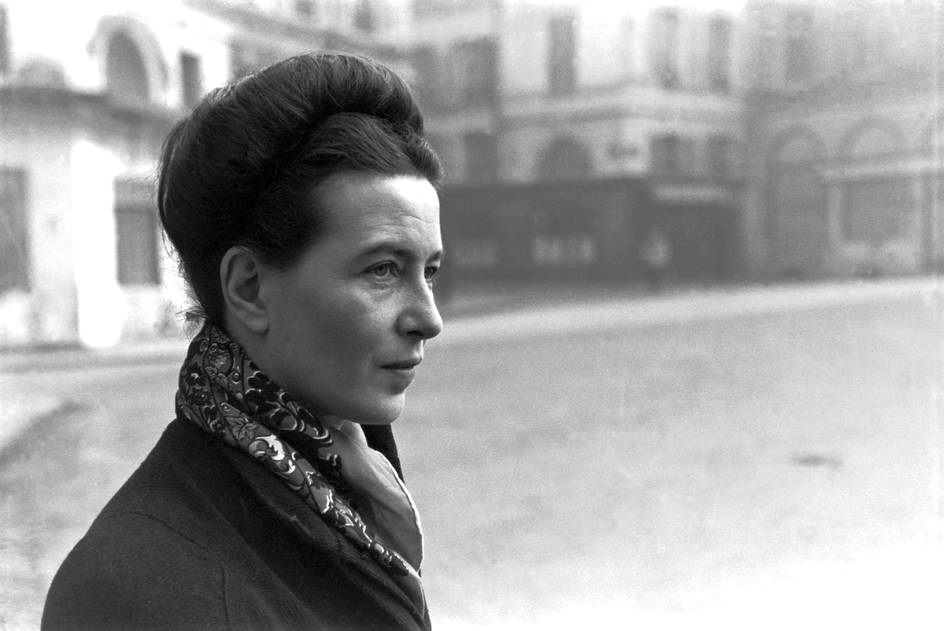
Simone de Beauvoir had introduced me to Jean Genet and Jean-Paul Sartre, whom I had interviewed. But she hesitated about being interviewed herself: “Why should we talk about me? Don’t you think I’ve done enough in my three books of memoirs?” It took several letters and conversations to convince her otherwise, and then only on the condition “that it wouldn’t be too long.”
The interview took place in Miss de Beauvoir’s studio on the rue Schoëlcher in Montparnasse, a five-minute walk from Sartre’s apartment. We worked in a large, sunny room which serves as her study and sitting room. Shelves are crammed with surprisingly uninteresting books. “The best ones,” she told me, “are in the hands of my friends and never come back.” The tables are covered with colorful objects brought back from her travels, but the only valuable work in the room is a lamp made for her by Giacometti. Scattered throughout the room are dozens of phonograph records, one of the few luxuries that Miss de Beauvoir permits herself.
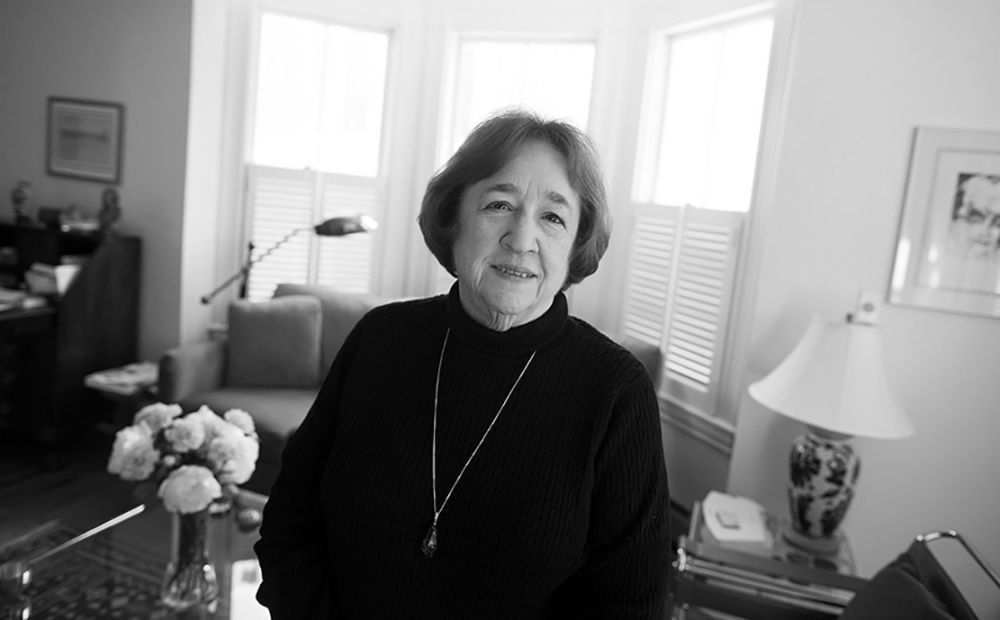
Apart from her classically featured face, what strikes one about Simone de Beauvoir is her fresh, rosy complexion and her clear blue eyes, extremely young and lively. One gets the impression that she knows and sees everything; this inspires a certain timidity. Her speech is rapid, her manner direct without being brusque, and she is rather smiling and friendly.
INTERVIEWER
For the last seven years you’ve been writing your memoirs, in which you frequently wonder about your vocation and your profession. I have the impression that it was the loss of religious faith that turned you toward writing.
SIMONE DE BEAUVOIR
It’s very hard to review one’s past without cheating a little. My desire to write goes far back. I wrote stories at the age of eight, but lots of children do the same. That doesn’t really mean they have a vocation for writing. It may be that in my case the vocation was accentuated because I had lost religious faith; it’s also true that when I read books that moved me deeply, such as George Eliot’s The Mill on the Floss, I wanted terribly much to be, like her, someone whose books would be read, whose books would move readers.
INTERVIEWER
Have you been influenced by English literature?
DE BEAUVOIR
The study of English has been one of my passions ever since childhood. There’s a body of children’s literature in English far more charming than what exists in French. I loved to read Alice in Wonderland, Peter Pan, George Eliot, and even Rosamond Lehmann.
INTERVIEWER
Dusty Answer?
DE BEAUVOIR
I had a real passion for that book. And yet it was rather mediocre. The girls of my generation adored it. The author was very young, and every girl recognized herself in Judy. The book was rather clever, even rather subtle. As for me, I envied English university life. I lived at home. I didn’t have a room of my own. In fact, I had nothing at all. And though that life wasn’t free, it did allow for privacy and seemed to me magnificent. The author had known all the myths of adolescent girls—handsome boys with an air of mystery about them and so on. Later, of course, I read the Brontës and the books of Virginia Woolf: Orlando, Mrs. Dalloway. I don’t care much for The Waves, but I’m very, very fond of her book on Elizabeth Barrett Browning.
INTERVIEWER
What about her journal?
DE BEAUVOIR
It interests me less. It’s too literary. It’s fascinating, but it’s foreign to me. She’s too concerned with whether she’ll be published, with what people will say about her. I liked very much “A Room of One’s Own” in which she talks about the situation of women. It’s a short essay, but it hits the nail on the head. She explains very well why women can’t write. Virginia Woolf is one of the women writers who have interested me most. Have you seen any photos of her? An extraordinarily lonely face . . . In a way, she interests me more than Colette. Colette is, after all, very involved in her little love affairs, in household matters, laundry, pets. Virginia Woolf is much broader.
INTERVIEWER
Did you read her books in translation?
DE BEAUVOIR
No, in English. I read English better than I speak it.
INTERVIEWER
What do you think about college and university education for a writer? You yourself were a brilliant student at the Sorbonne and people expected you to have a brilliant career as a teacher.
DE BEAUVOIR
My studies gave me only a very superficial knowledge of philosophy but sharpened my interest in it. I benefited greatly from being a teacher—that is, from being able to spend a great deal of time reading, writing and educating myself. In those days, teachers didn’t have a very heavy program. My studies gave me a solid foundation because in order to pass the state exams you have to explore areas that you wouldn’t bother about if you were concerned only with general culture. They provided me with a certain academic method that was useful when I wrote The Second Sex and that has been useful, in general, for all my studies. I mean a way of going through books very quickly, of seeing which works are important, of classifying them, of being able to reject those which are unimportant, of being able to summarize, to browse.
INTERVIEWER
Were you a good teacher?
DE BEAUVOIR
I don’t think so, because I was interested only in the bright students and not at all in the others, whereas a good teacher should be interested in everyone. But if you teach philosophy you can’t help it. There were always four or five students who did all the talking, and the others didn’t care to do anything. I didn’t bother about them very much.
INTERVIEWER
You had been writing for ten years before you were published, at the age of thirty-five. Weren’t you discouraged?
DE BEAUVOIR
No, because in my time it was unusual to be published when you were very young. Of course, there were one or two examples, such as Radiguet, who was a prodigy. Sartre himself wasn’t published until he was about thirty-five, when Nausea and The Wall were brought out. When my first more or less publishable book was rejected, I was a bit discouraged. And when the first version of She Came to Stay was rejected, it was very unpleasant. Then I thought that I ought to take my time. I knew many examples of writers who were slow in getting started. And people always spoke of the case of Stendhal, who didn’t begin to write until he was forty.
INTERVIEWER
Were you influenced by any American writers when you wrote your early novels?
DE BEAUVOIR
In writing She Came to Stay, I was certainly influenced by Hemingway insofar as it was he who taught us a certain simplicity of dialogue and the importance of the little things in life.